What is IPR and when do you need it?
TREATMENT
By
Dr. Rooz
Your Invisalign treatment plan lists something called IPR, and now you're picturing a drill, a grinding sound, and a tooth that's somehow smaller than it used to be. Take a breath. IPR is a routine, micro-precise step that helps your aligners do their job, and most patients barely notice it happening.
Here is what IPR actually is, why your provider might recommend it, and what to expect when it shows up on your treatment plan in Bellevue.
What IPR actually means
IPR stands for interproximal reduction. It's the gentle smoothing of a very thin layer of enamel between two teeth, usually measured in tenths of a millimeter. To put that in perspective, the average sheet of paper is about a tenth of a millimeter thick. We're talking about the kind of adjustment you cannot see in a mirror and cannot feel with your tongue.
That tiny sliver of space gives your teeth somewhere to move. Without it, certain shifts that your Invisalign plan calls for would not be physically possible.
Why your Invisalign plan might call for IPR
Invisalign works by moving teeth into specific positions over a series of trays. When teeth are crowded, there simply is not enough room in the arch for everything to line up. Your provider has a few options to create that room: expanding the arch, extracting a tooth, or performing IPR.
For mild to moderate crowding, IPR is usually the least invasive choice.
IPR is also used to refine tooth shape and contact points so that adjacent teeth meet evenly after treatment. Slightly oversized or oddly shaped teeth can leave small gaps or uneven edges once they're aligned. A bit of smoothing fixes that, and the final result looks more uniform.
In short, IPR helps with crowding, creates better contact between teeth, and gives the aligners the working space they need.
What it feels like at the appointment
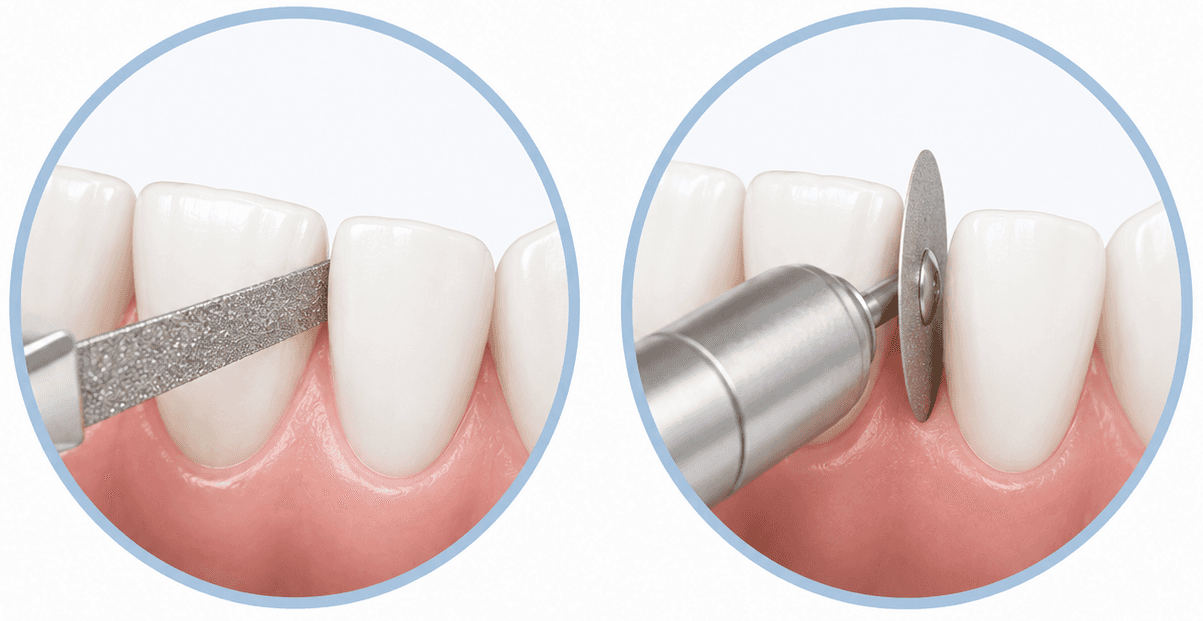
Most people are surprised by how unremarkable IPR is. Your provider uses either a fine diamond-coated strip that looks like a piece of sandpaper or a slow-speed handpiece with a thin disc. The process takes a few minutes per session, and there is no anesthesia required because enamel has no nerves.
You might hear a brief vibration or feel a light pressure between two teeth. That's it. No needles, no numbness, no recovery time. You walk out and eat lunch as planned.
IPR is usually done in stages across your treatment, not all at once. Your provider will perform a small amount at the visits the plan calls for, often right when you pick up the next set of trays.
Is removing enamel safe
This is the question almost every patient asks, and it deserves a clear answer. Research and decades of clinical use show that IPR, performed within accepted limits, does not increase the risk of cavities or gum problems. The amount of enamel removed is far less than the natural wear most teeth experience over a lifetime, and the smoothed surface is polished so plaque does not catch.
The key word there is limits. Your provider follows specific guidelines for how much enamel can safely be reduced between any two teeth across your full treatment. A digitally planned Invisalign case maps exactly where and how much, which is part of why we plan the entire course before the first tray goes in.
When IPR shows up in your plan
You'll typically see IPR scheduled at a few checkpoints during treatment, not at the very beginning. The earlier sets of trays use whatever natural space already exists. As teeth start to shift and the plan needs more room, your provider will perform IPR at the points where it's needed.
For some patients, IPR happens once or twice. For others with more crowding, it may be spread across several visits. Your provider will walk you through the schedule so there are no surprises.
A small step toward a straighter result
IPR sounds intimidating until you understand the scale. We're talking about a fraction of a millimeter of enamel, smoothed in a few painless minutes, that unlocks the alignment your treatment is built to deliver. It is one of the quietest, most routine parts of clear aligner care.
If you're considering Invisalign in Bellevue, or your treatment plan mentions IPR and you'd like a clear walkthrough, our team at 425 Clear Aligners is happy to talk it through.
Book a visit with 425 Clear Aligners for a personalized consultation.